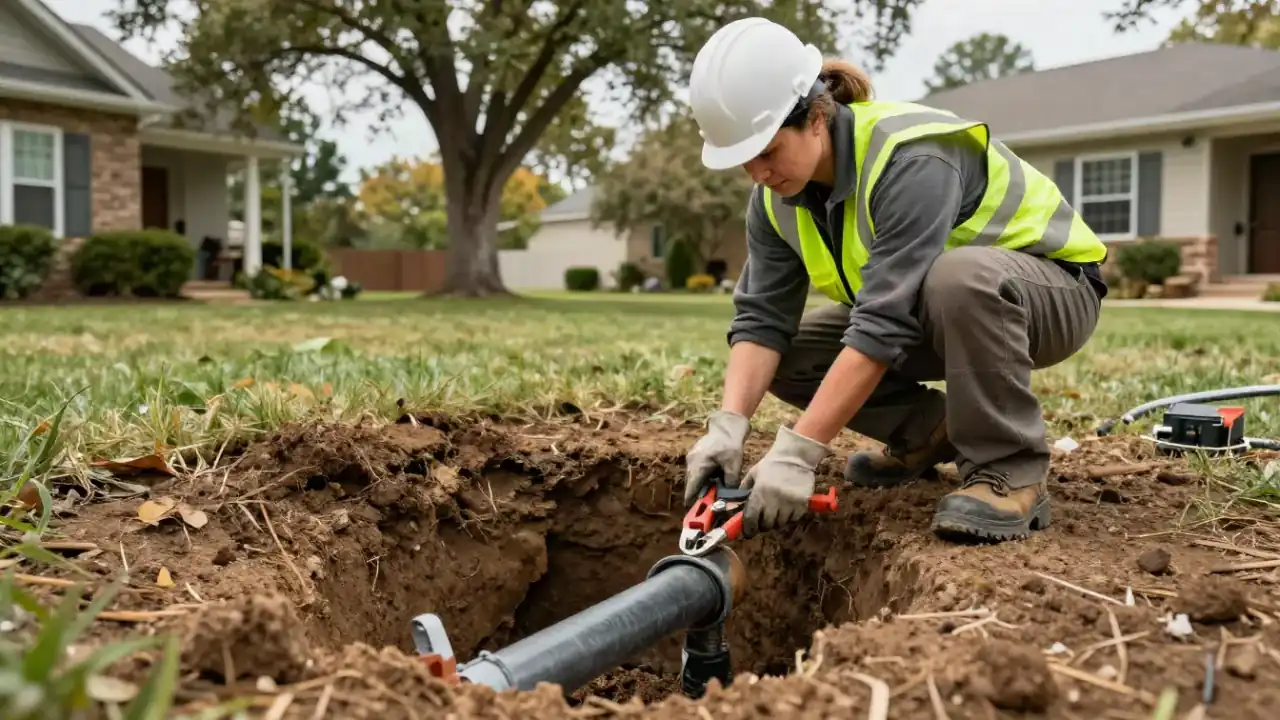
How Tree Roots Damage Sewer Lines
Tree roots damage sewer lines in Roswell GA by slipping through pipe joints and cracks, then swelling until the pipe collapses. Here is how to spot it and fix it.
Tree roots damage sewer lines in Roswell GA by entering through the pipe's joints, cracks, and loose connections, then growing into a mass that catches waste and eventually crushes the pipe. Roots don't break pipes open from the outside; they exploit the seams that already exist and widen them from within. In this post we'll walk through exactly how that happens underground, what warning signs show up first in your drains, what repairs cost in 2026, and how to stop it before your yard gets torn up.
How Tree Roots Get Into Sewer Lines in Roswell
Tree root intrusion is the process by which fine roots find moisture at a pipe joint and grow into the line, eventually forming a blockage or cracking the pipe wall. The roots themselves are not malicious; they are following water. A sewer line carries warm water, soap, and organic waste, and the condensation on the outside of a clay or PVC pipe is a beacon for any root tip within 20 feet.
Here is the sequence we see on almost every root job in Roswell:
- A hairline root, often thinner than a human hair, enters through a joint gasket or a hairline crack.
- Once inside, the root finds a constant supply of water and nutrients and grows aggressively.
- The root mass thickens, catching toilet paper, grease, and hair like a net.
- Pressure from the growing root mass widens the joint and can offset or collapse the pipe.
This is why a sewer line that was fine last summer can back up in a single week. The root doesn't just sit there; it grows. If you suspect this is happening, a sewer camera inspection Roswell GA is the only way to see the root mass and measure how far it has spread.
Why Roswell's Trees and Soil Make This Worse
Roswell's combination of mature hardwood canopy, clay-heavy soil, and older housing stock makes root intrusion more common here than in newer metro suburbs. The city has thousands of oaks, maples, and pines planted before the 1990s, and many of those trees sit within 10 feet of a sewer lateral. When the soil is clay, water doesn't drain away quickly; it lingers around the pipe, keeping the surface damp and inviting roots to stay.
We see this constantly in neighborhoods like Sewer Line Repair in Historic District, where homes built in the 1960s and 1970s still have original clay tile laterals. Clay tile is jointed every three feet, which gives roots hundreds of entry points along a single run. In Sewer Line Repair in Saddle Creek, the problem is often the opposite: newer PVC lines that were installed with a slight belly, holding a thin ribbon of water that roots can smell from 15 feet away.
Across the region, we handle Sewer Line Repair Roswell GA calls year-round, but the volume spikes in late summer and early fall when the ground is warm and roots are still actively growing before winter dormancy.
Warning Signs of Tree Root Damage in Your Sewer Line
The first sign of tree root damage is usually a single slow drain that gets worse over weeks, not a sudden flood. If only one fixture backs up, the blockage is likely close to that fixture; if multiple drains are slow, the root mass is probably in the main lateral. Here is what to watch for, in the order we typically see it:
- Gurgling toilets when you run the washing machine or shower.
- Slow drains in the lowest fixture in the house, often a basement floor drain.
- Sewage smell in the yard or near the cleanout.
- Lush green patch of grass over the sewer line, even in a dry spell.
- Backups that return a week after you snake the line.
That last one is the tell. If a drain cleaning buys you a week and then the same drain clogs again, you are not dealing with grease or hair. You are dealing with a root that regrew. At that point, snaking is a temporary fix, and you need to see the pipe. We use a camera on every repeat clog because it saves the homeowner from paying for the same snake three times.
What Trees Cause Sewer Line Damage in Roswell?
The trees most likely to cause sewer line damage in Roswell are willows, maples, oaks, poplars, and elms, followed closely by any large ornamental planted within 10 feet of the lateral. It is not about the species as much as the root structure and the tree's water demand. A mature silver maple can send roots 30 feet from the trunk in search of moisture. A willow is worse; it will travel 40 feet or more.
Pines are often blamed, but their roots tend to grow deeper and are less aggressive around shallow sewer lines. The bigger risk in Roswell is the oak canopy that was planted when the subdivision was built. Those trees are now 40 to 60 years old, and their root systems have had decades to find every joint in a clay lateral.
If you have a large tree within 10 feet of your cleanout, assume roots are already in the line. A root intrusion repair Roswell GA visit will confirm it and remove the mass before it causes a full blockage.
How Much Does Tree Root Sewer Repair Cost in Roswell GA?
Tree root sewer line repair in Roswell costs between $350 and $1,800 for a spot repair, $4,000 to $12,000 for a full lateral replacement, and $6,000 to $15,000 for trenchless methods, depending on length, depth, and access. Those are 2026 prices for this area, and they vary based on how much of the line is affected and whether the pipe is under a driveway, patio, or mature landscaping.
Here is how the options break down:
- Root removal only: $250-$600. This is a temporary fix; roots return.
- Spot repair: $350-$1,800. We cut out the damaged section and replace it with PVC.
- Sewer pipe lining (CIPP): $4,000-$10,000. A resin liner is cured inside the existing pipe, sealing cracks and joints.
- Trenchless replacement: $6,000-$15,000. We pull a new pipe through the old one without digging up the yard.
- Traditional excavation: $5,000-$14,000. More disruptive but sometimes necessary for collapsed clay tile.
We give you a flat price before we start, and we do not charge extra for the camera inspection if you move forward with the repair. If the line is a candidate for trenchless sewer line repair Roswell GA, we will tell you; if it is not, we will tell you that too.
Common Mistakes Homeowners Make With Root Intrusion
The most common mistake is treating a root blockage as a one-time clog. A snake or drain cleaner clears the drain, but it does not remove the root that caused it. Within weeks, the root regrows thicker and the backup returns. We have seen homeowners pay for the same drain cleaning four times in a year before finally getting a camera in the line.
Other mistakes we see:
- Pouring chemical root killer down the drain. It can kill a few roots, but it also damages the pipe and the bacteria in your septic system if you have one.
- Ignoring a single slow drain because it still drains. A slow drain is the early warning; a backup is the emergency.
- Planting new trees within 10 feet of the cleanout. Even a small ornamental can cause problems in 10 years.
- Assuming homeowner's insurance covers it. Most policies exclude sewer line damage from roots unless you have a specific rider.
If you are in Sewer Line Repair in Martin's Landing, where lots are wooded and lines are long, we recommend a camera inspection every 18 to 24 months, especially if you have had a root issue before.
How to Prevent Tree Roots in Sewer Lines in Roswell GA
Preventing tree roots in sewer lines comes down to three things: keeping roots away from the pipe, keeping the pipe sealed, and catching intrusion early. You cannot stop a determined root, but you can make your line a less attractive target.
Here is what actually works:
- Schedule a camera inspection every 2 years if you have trees within 15 feet of the lateral. It costs $150-$350 and catches roots before they become a blockage.
- Use a root inhibitor like copper sulfate only if your line is already root-free. It slows new growth but does not kill an established mass.
- Repair joint leaks promptly. A leaking joint is an open invitation. A spot sewer line repair Roswell GA on a small leak is far cheaper than a full replacement later.
- Consider a liner if your line is clay tile and has had one root repair. A sewer pipe lining Roswell GA seals every joint and crack in one pass, which stops roots from getting back in.
- Keep new trees at least 10 feet from the cleanout and 20 feet from the lateral run.
If you are buying a home in Roswell, a sewer lateral inspection Roswell GA before closing is the single best way to avoid inheriting a $10,000 root problem. We do these for buyers and sellers regularly.
When to Call a Professional
Call a professional when a drain backs up more than once in 30 days, when you see sewage in the yard, or when you hear gurgling in multiple fixtures at once. Those are signs the root mass is large enough to affect the whole line, and snaking will not fix it. We handle root intrusion, camera inspections, and trenchless repairs for homeowners across Roswell, and we will tell you honestly whether you need a spot fix or a full replacement.
If you are in a neighborhood like Sewer Line Repair in Willow Springs or Sewer Line Repair in Hembree Forest, we are usually on-site the same day you call. We find the root, remove it, and test the line before we leave.
Frequently Asked Questions
How do tree roots damage sewer lines in Roswell GA?
Roots enter through joints and cracks, then grow into a mass that catches waste and widens the opening. In Roswell's clay soil, roots stay shallow and find pipe joints within 10 to 20 feet of a mature tree. The damage is progressive, not instant.
Can tree roots grow through sewer pipes in Roswell Georgia?
Roots cannot grow through solid PVC, but they can enter through any joint, crack, or loose connection. Clay tile lines, common in Roswell homes built before 1980, have joints every 3 feet, giving roots hundreds of entry points. Once inside, they expand and can crack the pipe.
How much does tree root sewer repair cost in Roswell GA?
Spot repairs run $350-$1,800. Trenchless replacement runs $6,000-$15,000. Root removal alone is $250-$600 but is temporary. Most homeowners in Roswell spend $800-$2,500 for a permanent fix on a single damaged section.
Does homeowner's insurance cover tree root sewer damage in Roswell?
Most standard policies exclude root intrusion because it is considered a maintenance issue. Some policies cover the resulting water damage if it is sudden. Check your policy or ask your agent before you file a claim.
How long does a sewer line repair take?
A spot repair takes 4-8 hours. Trenchless replacement takes 1-2 days. Traditional excavation takes 2-4 days. We give you a timeline before we start and keep you updated if anything changes.
Get Help With Sewer Line Repair in Roswell
If you have a slow drain, a sewage smell in the yard, or a backup that keeps coming back, the root is not going away on its own. We will camera the line, show you exactly what is in there, and give you a flat price before we start. Call Roswell Sewer Line Repair at (770) 214-4809 and we will get your line flowing again.